



17-year-old Arnav analyses the Global South’s growing role in the development of artificial intelligence
If AI (artificial intelligence) is the defining technology of the 21st century, then the question is no longer who builds it – but who governs it.
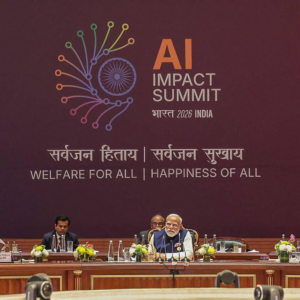
In early 2026, New Delhi became the centre of that debate. India hosted what its prime minister, Narendra Modi, described as “the world’s largest and historic AI Impact Summit… in a nation representing one-sixth of humanity”. As the first of its kind in the Global South, the summit registered more than 500,000 participants, dozens of heads of state and ministerial representatives and at least 100 global CEOs, the summit was not just another tech conference.
Here are six things you need to know about the event, and why they matter.
1. The scale – and the setting – are important
Held in New Delhi from 16-20 February 2026, the AI Impact Summit brought together 20 heads of state, nearly 60 ministerial-level representatives and delegations spanning 118 countries.
Brazil sent more than 300 officials led by President Luiz Inácio Lula da Silva, while French president Emmanuel Macron also attended. The United States delegation included more than 120 policymakers and industry leaders, reflecting the unusually broad mix of governments, diplomats and technology executives present at the gathering.
2. The CEOs who matter showed up
The summit also drew many of the executives shaping the global AI industry. Among those in attendance were Sundar Pichai, CEO of Google; Satya Nadella, CEO of Microsoft; Sam Altman, CEO of OpenAI; and Dario Amodei, CEO of Anthropic. Alexandr Wang, Meta’s chief AI officer, also participated.
The gathering extended beyond technology firms to include figures such as Børge Brende, president and CEO of the World Economic Forum, reflecting how AI policy is increasingly shaped where corporate strategy meets government regulation.
Harbingers’ Weekly Brief
Subscribe to the Harbingers’ Weekly Brief, a newsletter written by the editorial board of Harbingers’ Magazine, the world’s youngest newsroom, delivered to your inbox every Monday morning.
![slide image]()
![author_bio]()
![author_bio]()


Among the issues discussed were international safety standards for advanced AI systems, and watermarking and labelling of AI-generated content to combat deepfakes. Regulatory frameworks were also debated with regard to ensuring transparency, accountability and human oversight as AI expands into critical areas such as the economy, healthcare and the environment.
3. Investments – in the billions
The summit also underscored the scale of capital now flowing into AI – much of it tied to India’s growing role in the global AI economy. Indian industrials were among the largest investors: Reliance Industries pledged around $110bn toward AI infrastructure, while the Adani Group announced plans to invest $100bn by 2035 to build renewable-powered data centers.
Together with commitments from global technology firms and venture investors, the announcements formed part of more than $250bn in AI-related infrastructure, hardware and applications.
Microsoft also reiterated plans to invest $50bn by the end of the decade to expand AI access across the Global South. OpenAI CEO Sam Altman noted that India has become ChatGPT’s second-largest market after the United States, with more than 100 million weekly users, while Anthropic announced its first Indian office in the city of Bengaluru to support its rapid adoption in the past months.
4. India’s AI startup ecosystem is exploding
As the world’s most populous country and the fastest-growing major economy, India has become a key market and testing ground for new technologies.
As of early 2026, India hosts more than 6,200 active AI startups, making it the world’s third most competitive AI market.
Around 89% of new startups launched in the past year integrate AI into their products or services.
At the summit, France’s Macron praised India’s digital transformation, recalling how a street vendor who once lacked a bank account ten years ago can now accept payments on his phone. “That is not a technology story,” Macron said. “That is a civilisational story.” He pointed to India’s digital identity system serving more than 1.4 billion people as an example of the public digital infrastructure now helping power the country’s next wave of AI innovation.

5. AI for social good, not just profits
Beyond commercial competition, the summit also highlighted how AI could be used to tackle real-world social challenges. Its agenda was structured around three guiding pillars – People, Planet, and Progress – reflecting the idea that artificial intelligence should serve public needs as well as corporate ones.
Organisers released six global AI Impact Casebooks documenting more than 170 real-world AI deployments across six sectors: health, energy, agriculture, education, gender empowerment and accessibility. These were developed in partnership with organisations such as the World Health Organisation (WHO), the International Energy Agency, UN Women and the World Bank.
On the exhibition floor in New Delhi, that vision was evident. Examples included AI systems helping farmers forecast crop yields; tools designed to reduce energy emissions; and assistive technology for visually impaired users.
View this post on Instagram
6. On the brink of an ‘AI divide’
Despite the optimism surrounding AI’s potential, several speakers also warned that its rapid development could widen existing global wealth gaps and unequal access to opportunity.
Google DeepMind CEO Demis Hassabis warned of what may be coming next: “If I were to try and quantify what’s coming down the line with the advent of AGI, it’s going to be something like ten times the impact of the Industrial Revolution, but happening at ten times the speed – probably unfolding in a decade rather than a century.”
Artificial general intelligence (AGI) refers to systems capable of performing most cognitive tasks at or beyond human-level intelligence, rather than being limited to narrow functions.

Such acceleration raises concerns that countries lacking computing power, technical expertise, and digital infrastructure may fall further behind. Driven by skill gaps and technological change, structural unemploymentalready affects more than 250 million workers worldwide.
Global unemployment currently hovers around 190 million people, but economists warn that automation and uneven access to AI could deepen existing disparities if the benefits of the technology are not broadly shared.
Taken together, the discussions in New Delhi suggested that the race for AI is no longer confined to Silicon Valley or Beijing. As investment, computing infrastructure, and AI talent expand beyond traditional spheres of power and influence, more countries are beginning to play a role in the technology’s development.
What emerges over the next decade will depend not only on breakthroughs in AI itself, but on how widely its capabilities – and economic gains – are distributed across the global economy.

Edited by:

© 2026 The Oxford School for the Future