17-year-old Stephanie debates the arguments for repatriation and reflects on her recent experience at several museums
This summer, I visited more than ten museums across Europe and the United States containing historical, art and ethnographic collections. Repatriation – the act of returning an object to its country or community of origin – has been at the centre of many of them.
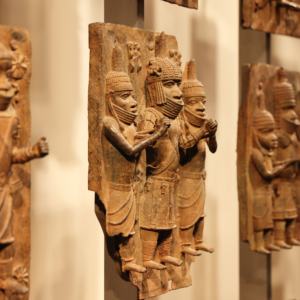
At Berlin’s Ethnological Museum, that question became more visible through what are known as the “Benin Bronzes”. The umbrella term refers to thousands of artifacts, including plaques, sculptures, carvings and objects made from materials including brass, bronze and ivory, created over the 14th to 17th centuries in the Kingdom of Benin, in what is now southern Nigeria.
Today, they are scattered across museums and collections around the world, including the British Museum in London and the Metropolitan Museum of Art in New York City. How they got there is central to the debate about whether they should remain there.
Many of the objects were looted by British troops during the invasion of Benin City in 1897, as Britain sought to expand its colonial and commercial control in the region.
The attack took place during the wider “Scramble for Africa” towards the end of the 19th century, when several European powers invaded, colonised and divided much of the African continent. Many of the looted objects were subsequently sold and dispersed among European museums and private collections.
Reasons for repatriation
A key argument for repatriation is how closely the removal of the Benin Bronzes from their original owners is tied to colonial power and violence. Holding on to the items can be seen as a glorification of colonialism.
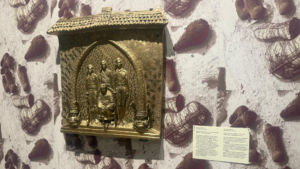
A 2022 artwork by artist Phil Omodamwen – a sixth-generation bronze caster whose work engages with the campaign for the return of the Benin Bronzes – caught my attention in the Berlin musuem. It depicts an Oba (king) surrounded by British guards. The figure is Oba Ovonramwen, the ruler of Benin at the time of the British conquest in 1897.
Another argument for repatriating the Benin Bronzes concerns their cultural and spiritual significance. The objects were not created simply as artworks for display: many had political, historical, ceremonial and spiritual functions within the Kingdom of Benin and its royal court, and remain closely connected to the history and cultural heritage of the Edo people.
For supporters of restitution, displaying these objects in foreign institutions separates them from the cultural contexts in which they were created and understood. Many of the Bronzes remain physically removed from the Edo communities and traditions in which their histories are rooted.
Their return is also a question of corrective justice: if cultural objects were acquired through military violence and colonial dispossession, returning them can be understood as one way of addressing that historical injustice.
But that proposition produces a more difficult question – if they should be returned, who should receive them?
View this post on Instagram
Return to whom?
Nigeria has advocated for the return of Benin artefacts for decades, beginning in 1960 when the country gained independence from Britain. The British Museum, which holds a significant collection of Benin objects, has faced repeated calls for their return.
The modern Nigerian state did not exist when the objects were created. Many were associated specifically with the royal court of the Kingdom of Benin and the Oba of Benin. Contemporary restitution therefore raises questions about the respective roles of Nigeria’s federal government, museums and cultural institutions, and the Oba and Edo communities.
Returns of Benin objects have taken place at both personal and institutional levels. In 2014, a British medical consultant who had inherited two Benin objects from his grandfather gave them to Oba Erediauwa, whose grandfather was Oba when the bronzes were taken.
In 2021, the Metropolitan Museum of Art also returned two Benin Bronzes to the Nigerian government. Last year, the Netherlands also returned 119 objects to the government, followed by an art museum in Boston returning two.
This complicates the assumption that returning an object to its country of origin automatically resolves the question of ownership. It also raises a broader question: what does ‘repatriation’ actually mean?
View this post on Instagram
What does it mean to return an object?
The word ‘repatriation’ has its roots in the Latin word patria, meaning homeland or native country. Former colonial powers and the institutions within them have faced growing pressure to return cultural objects acquired through colonialism, conflict and dispossession.
One important example comes from the United States. The Native American Graves Protection and Repatriation Act (NAGPRA) provides a legal process for certain Native American human remains and cultural items held by federal agencies and federally funded museums to be returned to lineal descendants, Native American tribes or Native Hawaiian organisations.
I encountered another version of this debate during a visit to Chicago’s Field Museum. As I walked through the museum, parts of its Native American displays were concealed from public view, with signs explaining that repatriation work was underway.
This led me to the history of another group of contested objects, those removed following the massacre of 250 Lakota people at Wounded Knee, South Dakota in 1890.

During this period of violence, displacement and dispossession, the Ghost Dance religionemerged among Indigenous communities in the American West. For its followers, it offered hopes of spiritual and cultural renewal and the restoration of Indigenous ways of life, but US authorities viewed the movement with suspicion and hostility.
After the massacre in 1890, a number of related objects were removed from the Wounded Knee site and eventually entered museum collections. Some have since been returned, including objects repatriatedfrom Glasgow in 2022.
Charles New Holy, a representative of descendants of Wounded Knee survivors, toldthe Smithsonian magazine: “Those items belong to our grandfathers and grandmothers – their spirit is still connected to them – but people see prestige and money in them. These are spiritual items that should not be displayed anywhere.”
The case for keeping collections
There are also arguments against large-scale repatriation.
Supporters of encyclopaedic museums argue that institutions such as the British Museum allow artefacts from different societies to be viewed by an international audience rather than limiting access to their countries of origin. They also argue that large museums may have greater resources for conservation, research and public access.
Finally, repatriation can raise difficult practical questions. Determining which community or institution has the strongest claim to an object can be complicated, particularly when borders, political institutions and cultural identities have changed over time.
The debate over the Benin Bronzes therefore extends beyond the question of where individual objects should be displayed. It asks us to consider whether legal possession is the same as ownership, how the circumstances in which an object was acquired should shape its future, and who should have the right to decide where the past belongs.

Edited by:

© 2026 The Oxford School for the Future